No Inquiries on Your B2B E-commerce Website? 5 Critical Reasons + A Guide to Boosting Conversions (2026 Updated Edition)
In the international trade industry, there’s a very common yet frustrating problem: websites generate traffic but receive no inquiries. Many companies invest in Google Ads or SEO every month; while their analytics show that visitor numbers are growing, their inboxes still don’t receive any new customer inquiries.
In English, this type of situation is usually referred to as “B2B website with no inquiries”。
But the real issue is often not traffic, but conversion.
Simply put, most independent e-commerce sites for international trade aren’t designed to be “lead-generation machines.”
How do overseas buyers make decisions?

Before optimizing any website, it is essential to understand one core principle: B2B procurement is, by its very nature, a risk assessment—not an impulse purchase.
When overseas buyers visit your website, they usually don’t request a quote right away; instead, they’re constantly weighing their options in their minds:
Does this company actually exist?
Do you have the capacity to manufacture the products I need?
Are there any risks associated with this partnership?
Is it worth taking the time to send an inquiry?
Every page, every image, and every piece of text on the website influences this decision. If these questions aren’t clearly answered, customers are highly unlikely to proceed to the next step.
Misconception #1: Treating a Website as an “Electronic Brochure”
The homepages of many foreign trade websites are filled with information such as company profiles, dates of establishment, and number of employees, while the product pages simply display images and specifications.
But overseas customers aren't interested in your company's history; they're more concerned with whether you can solve their problems.
An effective website homepage should be designed around “customer value,” rather than a company’s self-promotion.
A well-structured presentation typically includes: a clear value proposition, testimonials, a breakdown of products or solutions, unique selling points, and a clear call to action.
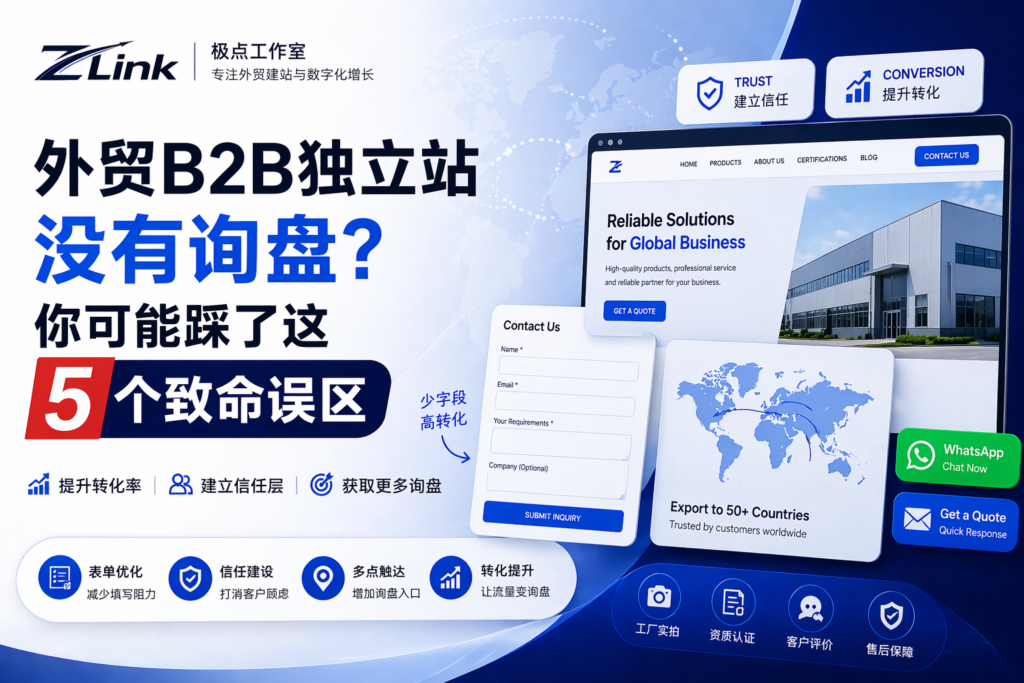
Misconception #2: The inquiry form is too complicated
Many websites include a large number of fields in their contact forms, such as company name, job title, phone number, address, purchase volume, and budget.
This approach can significantly reduce conversion rates. Studies show that for every additional form field, the probability that a user will complete the submission drops significantly.
A more reasonable approach is to keep the form simple and include only the necessary information, such as name, email address, and a description of your needs. Company name can be an optional field.
In addition, adding a clear promise next to the form—such as “We will respond within 24 hours”—can effectively boost customer trust and encourage them to submit the form.
Misconception 3: Product pages lack customization information
In B2B business, the ability to customize is often one of the factors that customers care about most.
If a product page only lists standard specifications without specifying whether customization is available, customers typically won’t ask about it on their own—they’ll simply leave the website to find a supplier that provides clearer information.
Therefore, each product page should clearly state the minimum order quantity, customization options, sample policy, and lead time. This information can significantly reduce the cost of decision-making for customers, thereby increasing the likelihood of inquiries.
Misconception 4: Lack of Trust
When customers are unable to visit a factory in person, their trust in a supplier depends entirely on the information provided on the website.
If a website lacks authentic photos, certifications, or customer case studies, it’s difficult for users to build trust.
Effective trust-building elements include authentic photos of factory or office environments, brief video demonstrations, authoritative certification documents, customer reviews, and information on export market distribution.
This content doesn't need to be overly complicated, but it must be authentic and specific.
Misconception 5: Too Few Channels for Inquiries
Many websites only provide contact information on their “Contact” page, and this design significantly limits conversion opportunities.
Different users are at different stages of the decision-making process while browsing, and they need to see the right call-to-action at the right time.
A more reasonable approach is to provide multiple entry points for inquiries, such as a "Request a Quote" button on product pages, a "Contact Us" link in the sidebar, and a live chat tool visible throughout the site.
The key principle is that users should be able to easily find a way to contact you on any page, without having to search for it.
How Can You Tell If There's a Problem with Your Website?
You can quickly assess your situation by asking yourself the following questions:
Does your homepage clearly explain your target audience and the solutions you offer?
Is the inquiry form concise enough?
Does the product page include customization information?
Does the website display authentic content that builds trust?
Are there contact options available in multiple locations?
Is the website loading fast enough?
If multiple items fail to meet the standards, the problem is likely with the conversion funnel rather than the traffic itself.
How Can You Improve the Conversion Rate of Inquiries on a B2B Website?
If an international trade website isn’t receiving any inquiries, the key to increasing inquiries can be summarized in two points: reducing the customer’s decision-making risk and minimizing friction in the process.
Specifically, you can start by optimizing form structure, enhancing trust-building content, clarifying product information, and adding conversion entry points.
These optimizations typically do not require a major website overhaul, but they can significantly improve conversion rates.
Conclusion
An international trade website that consistently generates leads isn’t simply built overnight; it’s a system that’s developed through continuous optimization.
If you already have a website but aren’t seeing the results you want, you should prioritize optimizing it by simplifying forms and building trust.
If you're planning to rebuild your website, designing it with “conversion” as the core focus from the very beginning will significantly improve your return on investment down the line.
About Us
We specialize in providing high-conversion standalone website solutions for foreign trade companies, offering comprehensive implementation support—from website structure design to SEO optimization, and from server deployment to lead conversion strategies.
👉 Get a website-building plan:https://gozlink.com/website-development/
👉 Technical Support:https://gozlink.com/support/